

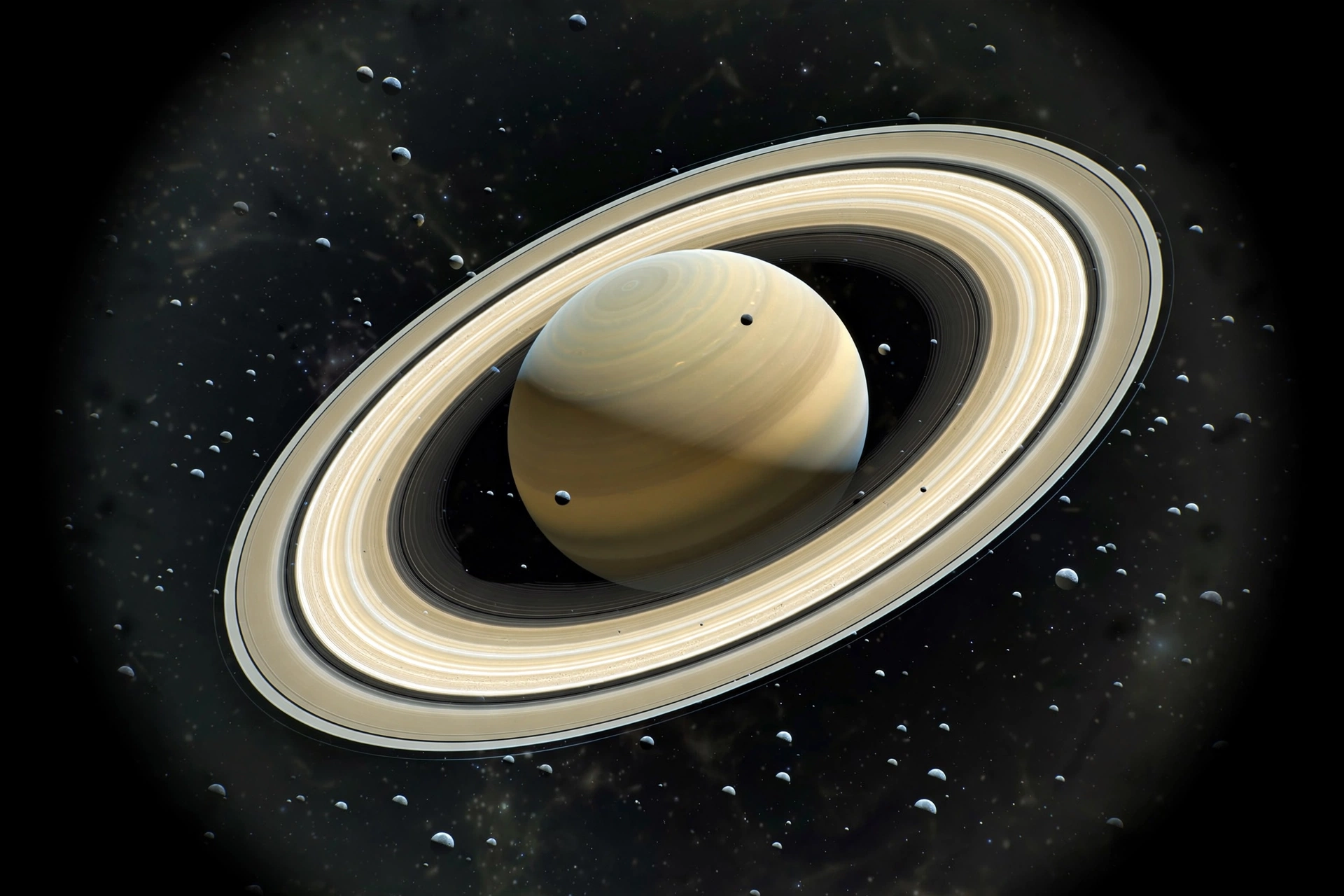
Saturn has tightened its grip on one of the solar system’s most striking records. Astronomers have confirmed 128 new moons orbiting the ringed planet, taking its official total to 274 — comfortably the largest family of moons known around any planet. The new arrivals are small, faint and irregular, yet together they transform our picture of the Saturn system and raise fresh questions about how such a crowded neighbourhood formed.
The discoveries come from a patient survey carried out with the Canada-France-Hawaii Telescope, where researchers tracked dim specks of light moving with Saturn across successive observing seasons. Teams including scientists at the University of British Columbia compared images taken over several years, linking fleeting detections into reliable orbits before the finds could be formally recognised.
How the new moons were found
None of the newcomers is anything like Earth’s large, round Moon. Most are rocky fragments only a few kilometres across, following tilted, elongated paths far from the planet. They belong to the so-called irregular moons, bodies thought to have been captured by Saturn’s gravity long ago or produced when larger captured objects shattered in collisions.
Because these fragments are so faint, finding them requires a technique known as stacking, in which dozens of telescope exposures are shifted at Saturn’s rate of motion and combined. Objects moving with the planet grow brighter in the stack, while background stars blur away. Each candidate then has to be followed long enough for its orbit to be calculated with confidence.
Why formal recognition matters
A detection alone does not make a moon official. The International Astronomical Union reviews the orbital evidence before adding a body to the recognised list, which is why announcements of this kind often arrive in batches years after the first images were taken. With recognition now granted, Saturn’s tally of 274 puts it far ahead of Jupiter, its nearest rival.
The result also underlines how incomplete our census of the outer solar system remains. If telescopes can still uncover more than a hundred moons around a planet studied for centuries, smaller and darker populations almost certainly await discovery around the other giant planets as instruments improve.
Clues to a violent past
For planetary scientists, the value of the new moons lies less in the headline number than in what their orbits reveal. The fragments cluster into families that appear to share a common parent body, suggesting collisions smashed bigger moons apart and scattered the debris. Dating those break-ups could help researchers reconstruct how the early solar system evolved.
There is a lively debate about whether some families are surprisingly young, perhaps the product of impacts within the last few hundred million years. If so, Saturn’s surroundings are far more dynamic than the serene image of the rings might suggest. Our recent coverage of how large technology systems behave in unexpected ways, in our report on the Microsoft AI doom loop warning, shows a similar lesson from a very different field: complex systems reward those who keep watching them closely.
What happens next
Each confirmed moon will eventually receive a formal name, drawn in Saturn’s case largely from Norse, Inuit and Gallic mythology. Meanwhile, survey teams plan to push the search fainter still, testing whether the tally climbs higher or whether astronomers are finally approaching the true limit of what exists to be found.
A system still being mapped
It is also worth remembering how unevenly Saturn’s moons are distributed. A small number of large, bright moons dominate public imagination, while hundreds of small bodies share the outer reaches in loose families. That imbalance is itself a clue: it suggests Saturn’s gravity gathered material over an immense span of time, keeping some objects intact, grinding others down, and constantly rearranging the inventory that astronomers are only now able to read in full.
The practical consequence of a bigger catalogue is better science per observation. Every future image of the Saturn system can now be checked against 274 known positions, reducing the chance that a known moon is mistaken for something new and increasing the chance that a genuinely unknown object stands out. In that sense, this announcement improves not only what astronomers know, but how reliably they can learn whatever comes next.
For now, the ringed planet stands alone. With 274 recognised moons, Saturn is not merely ahead in the count — it has redefined how rich a single planetary system can be.
