

Global business has changed dramatically over the past decade. Technology has made it easier for companies to operate across borders, connecting with clients, partners, and audiences worldwide. For businesses entering international markets, translation service providers play a key role in ensuring messages are accurate and culturally appropriate.
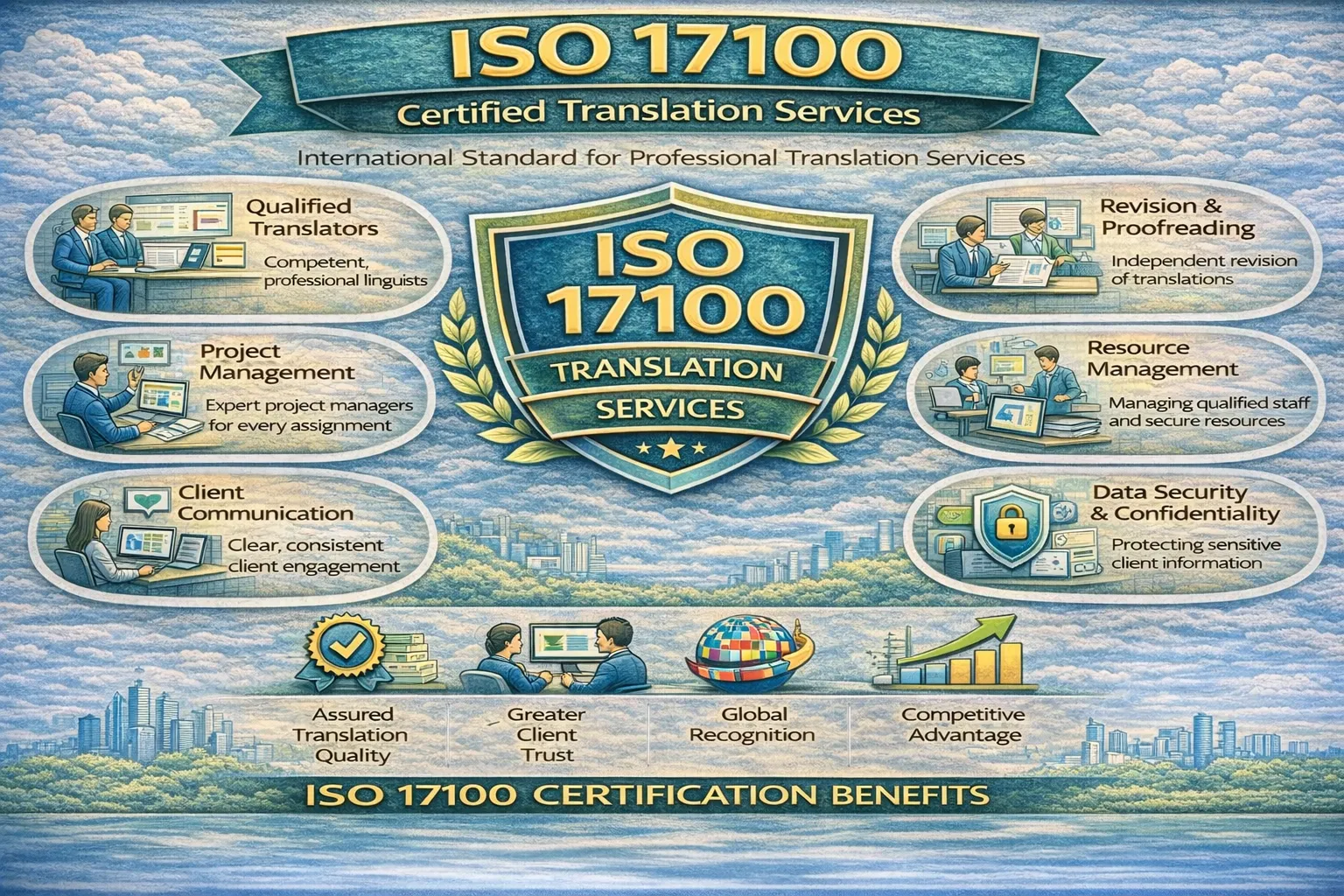
Obtaining ISO 17100 certification brings multiple benefits. Translation providers gain enhanced credibility, better-organized workflows, a competitive advantage, and higher overall service standards. For clients, the standard guarantees translations that are consistent, accurate, and delivered efficiently.
This article explains everything you need to know about ISO 17100, helping you make an informed decision when selecting a translation partner. We will start with the basics, then move on to processes, requirements, and the advantages of working with certified providers.
ISO 17100 Explained: What It Covers
ISO 17100 was introduced in 2015 to establish international guidelines for translation service providers. The standard focuses on processes, personnel qualifications, and structured workflows to ensure reliable, high-quality translations.
It is important to note that ISO 17100 applies only to written translations. Spoken interpretation and other verbal services are not covered. Machine translation post-editing (MTPE) is generally outside the scope of this standard. The primary goal is to ensure human translation meets professional standards while being consistent and reliable.
By following ISO 17100, providers demonstrate that their translation practices align with industry best practices. At Linguitronics, we have long implemented these standards to ensure that client projects are handled with precision and professionalism.
Who Should Work with ISO 17100-Certified Providers
ISO 17100 is mainly relevant for translation service providers, but its benefits extend to clients as well. Agencies that adhere to the standard follow structured workflows, use qualified personnel, and implement quality assurance procedures. While companies without certification may still produce good translations, ISO 17100 certification simplifies the decision-making process for clients.
Industries that demand high accuracy benefit the most. In healthcare, for instance, medical translation services ISO 17100 ensures patient records, regulatory documents, and clinical trials are translated with both linguistic precision and subject-matter expertise. This standard provides reassurance that critical documents are handled correctly.
The Role of ISO 17100 in a Technology-Driven World
The rise of AI and machine translation tools has transformed the translation industry. While these technologies increase efficiency, they cannot replace human expertise in understanding context, cultural nuances, and complex terminology. ISO 17100 provides a human-centered framework, defining roles, responsibilities, and checkpoints to maintain translation quality.
When AI tools are used alongside ISO-compliant workflows, translation providers can handle large volumes of work without sacrificing accuracy. This ensures that translations remain precise and contextually appropriate, even in fast-paced or high-volume projects.
Does ISO 17100 Guarantee Translation Quality?
ISO 17100 does not explicitly define translation quality. Instead, it establishes procedures and frameworks that make achieving high-quality translations possible. By following these structured processes, providers ensure accuracy, consistency, and accountability. Clients can trust that translations are produced professionally and meet agreed-upon standards.
Key Steps in the ISO 17100 Translation Workflow
ISO 17100 specifies several important steps to maintain consistent quality:
1. Translator Qualifications and Expertise
Every translator must meet recognized qualifications, such as a degree or certification, and be evaluated for subject-matter expertise. This ensures they can handle technical, medical, or specialized content accurately.
2. Planning Before Translation
Before starting, project managers collaborate with clients and translators to define project objectives, target audience, and quality requirements. Planning may involve preparing glossaries, style guides, or reference materials. This stage ensures that all stakeholders share the same expectations and that translations remain consistent.
3. Translation and Review
Qualified translators perform the initial translation, followed by a thorough review by a second professional. This step ensures that translations maintain accuracy, readability, and compliance with client specifications.
4. Client Feedback and Revisions
ISO 17100 requires a structured process for incorporating client feedback. Revisions are implemented systematically, and lessons learned are applied to future projects. This process guarantees continuous improvement and client satisfaction.
5. Data Security Measures
Many translations involve sensitive information, such as medical records or corporate documents. ISO 17100 mandates secure handling of all client data, controlled access to translation resources, and proper storage. This protects confidentiality and ensures accountability throughout the project.
ISO 17100 Requirements for Translation Agencies
To comply with ISO 17100, providers must:
- Assign projects to qualified translators
- Implement structured workflows and quality assurance measures
- Maintain proper management of resources and technologies
- Ensure data privacy and security
Meeting these requirements signals professionalism and reliability to clients, making it easier to select a trusted partner for complex translation projects.
Translator Qualification Criteria
ISO 17100 defines three pathways for translator qualification:
- Hold a recognized translation degree or certification
- Hold a degree in another field with at least two years of professional translation experience
- Accumulate five or more years of full-time professional translation experience
These pathways ensure that translators have both theoretical knowledge and practical experience to manage complex projects efficiently.
Advantages of Using ISO 17100 Providers
ISO 17100 certification benefits both providers and clients. Providers gain a structured system for organizing projects, improving efficiency, and ensuring consistent quality. Clients enjoy reliable translations delivered according to internationally recognized standards.
Integrating modern tools such as CMS and TMS enhances these processes by streamlining workflows, managing translation memory, and maintaining terminology databases. This approach reduces repetitive work, ensures consistency across projects, and protects sensitive client data.
Applications Across Industries
ISO 17100 is a critical standard for translation service providers, demonstrating their ability to consistently deliver high-quality translations across multiple industries. Its structured framework ensures standardized processes, optimized workflows, and output that meets internationally recognised criteria. This makes it particularly valuable in sectors where precision, clarity, and compliance are essential, and where errors can have serious consequences.
Key industry applications include:
- Healthcare and Medical Translation
- Ensures accurate handling of patient records, clinical research documents, pharmaceutical materials, and regulatory submissions.
- Supports patient safety and compliance with regulatory standards by minimising translation errors.
- Provides a structured workflow where translations are reviewed systematically and verified by qualified professionals.
- Ensures accurate handling of patient records, clinical research documents, pharmaceutical materials, and regulatory submissions.
- Financial Sector
- Maintains accuracy in financial statements, audit reports, investment prospectuses, and compliance documents.
- Reduces the risk of misinterpretation, legal disputes, or regulatory penalties.
- Ensures precise terminology and standardized quality control throughout all documentation.
- Maintains accuracy in financial statements, audit reports, investment prospectuses, and compliance documents.
- Legal Services
- Guarantees reliability in contracts, court documents, patents, and intellectual property agreements.
- Combines linguistic accuracy with a deep understanding of legal terminology and local regulations.
- Structured review and documentation processes make translations defensible in legal contexts.
- Guarantees reliability in contracts, court documents, patents, and intellectual property agreements.
- Technical and Engineering Fields
- Supports accurate translation of manuals, technical specifications, engineering drawings, and safety guidelines.
- Minimizes risk of errors that could affect product performance, safety, or compliance.
- Incorporates terminology management, subject-specific expertise, and rigorous quality control.
- Supports accurate translation of manuals, technical specifications, engineering drawings, and safety guidelines.
- Marketing, Education, and Government
- Ensures consistent messaging, brand integrity, and clarity in policy or educational materials.
- Demonstrates business capability in managing diverse projects efficiently.
- Provides culturally sensitive translations that meet the expectations of global audiences.
- Ensures consistent messaging, brand integrity, and clarity in policy or educational materials.
Overall, ISO 17100 provides a universal benchmark that enhances reliability, efficiency, and professionalism across all sectors. By following its principles, translation service providers strengthen operational performance and instill client confidence that documents—whether medical, legal, financial, or technical, are handled with precision, expertise, and adherence to internationally recognised quality standards.
