

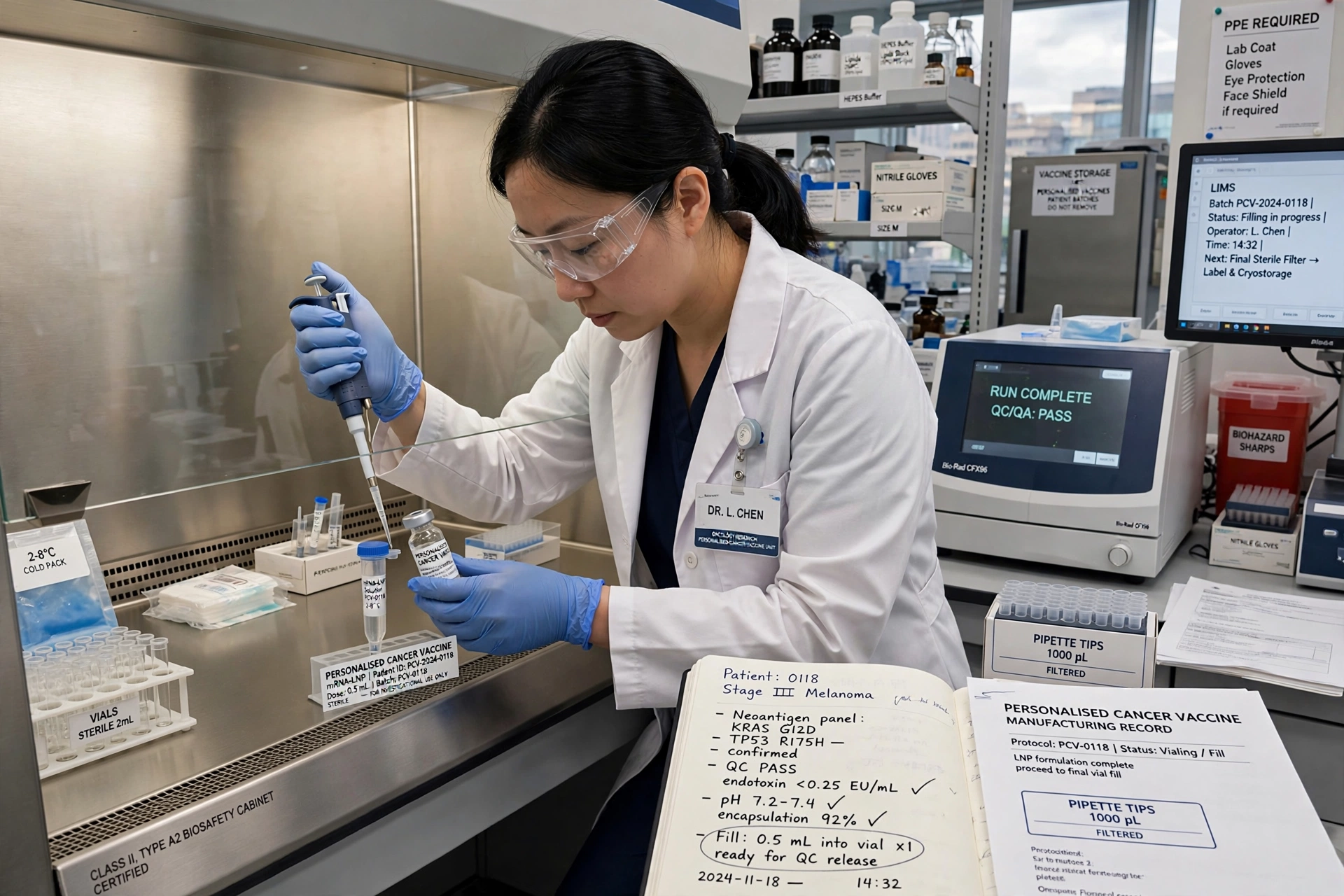
A personalised cancer vaccine tailored to each patient’s tumour has cleared an important early hurdle in ovarian cancer, according to a phase 1 trial published in Nature Medicine. The study found that the vaccine, known as NeoVax, could be manufactured and given alongside the immunotherapy drug nivolumab with an acceptable safety profile in women whose cancer was platinum-sensitive.
The result is deliberately modest, and the researchers are careful to present it that way. Phase 1 trials are designed first and foremost to test safety and practicality, not to prove that a treatment works. Even so, in a disease where new options are badly needed, demonstrating that a bespoke vaccine can be built and delivered on schedule is a meaningful step.
How a personalised vaccine is made
NeoVax is not an off-the-shelf product. Scientists sequence the DNA of a patient’s tumour and compare it with healthy tissue to find mutations unique to the cancer. Computer algorithms then predict which fragments of those mutated proteins — called neoantigens — are most likely to alert the immune system, and a unique vaccine is manufactured for that individual.
The aim is to teach the patient’s own T cells to recognise the cancer as foreign. In this trial the vaccine was combined with nivolumab, a checkpoint inhibitor that releases a molecular brake on immune cells, in the hope that trained T cells would then be free to attack the tumour more effectively.
What the trial actually showed
The published findings focus on feasibility and safety. Making a personalised vaccine is a race against time, because treatment cannot wait indefinitely while a product is designed and produced. The team showed the process could be completed for enrolled patients and that side effects were manageable and broadly in line with expectations for this kind of therapy.
What the study cannot tell us yet is whether the vaccine extends life or delays recurrence. The group of patients was small, there was no comparison arm, and ovarian cancer outcomes vary widely. Anyone reading coverage of space milestones, such as our report on the SpaceX launch jellyfish cloud seen over the US East Coast, will recognise the pattern: a genuine advance, reported carefully, whose full significance only becomes clear with time.
Why ovarian cancer is a hard target
Ovarian cancer is often diagnosed late and, although many patients respond at first to platinum-based chemotherapy, the disease commonly returns. Platinum-sensitive disease — where cancer responds again after a break from platinum drugs — offers a window in which immune-based approaches might be tested, but tumours in the ovaries are notably good at hiding from the immune system.
That is precisely why a vaccine built from a tumour’s own mutations is attractive. Rather than aiming at a target shared by many patients, it aims at the private molecular fingerprints of one person’s cancer, which the immune system should, in theory, find easier to distinguish from healthy tissue.
The road ahead
Larger, randomised trials will be needed to learn whether adding NeoVax improves outcomes, and researchers will also study blood and tissue samples from this study to see how strongly the vaccine stimulated immune responses. Manufacturing speed and cost remain practical challenges for any therapy made one patient at a time.
Listening to the immune system
Alongside the headline findings, the trial’s laboratory work may prove just as influential. By examining blood samples taken before and after vaccination, researchers can measure whether patients produced T cells targeted at their tumour’s neoantigens, how many distinct targets provoked a response, and how durable those responses were. Patterns in that data could reveal which vaccine designs deserve to advance and which patients are most likely to benefit.
That kind of detail matters because personalised therapies cannot be improved by guesswork. Each design choice — how many neoantigens to include, how they are delivered, how doses are spaced alongside nivolumab — can now be tested against real immune measurements from real patients. Even if this particular combination does not proceed unchanged, the evidence gathered here gives the next generation of ovarian cancer vaccines a far better starting point than theory alone could provide.
For patients and families, the sensible reading of this news is cautious encouragement. An early trial has shown that a highly personal form of treatment can be delivered safely — the necessary first chapter, though not yet the story, of a possible new approach to ovarian cancer.
