

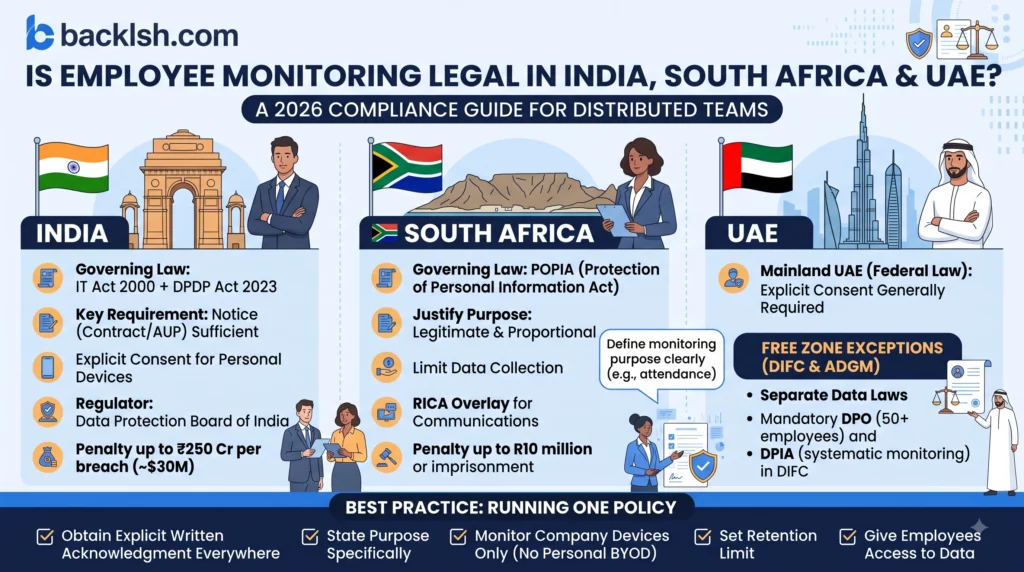
There has been an emphasis on business efficiency, improving productivity and innovation in the UAE ecosystem. Monitoring workplace activities is mainly for business purposes, which is done as per the UAE laws on data protection, UAE labor laws, cybercrime laws, and local security laws. The monitoring is done under legal and valid reasons. Local Advocates are always a good alternative source to grab legal advice or full time support.
UAE labor laws for monitoring the Labor force:
UAE labor laws such as Federal Decree-Law No. 33 of 2021 and other laws have always supported the employee-employer relationship. It strengthens their relationship and ensures improved productivity from workers’ end.
However, it also ensures there is fair treatment of employees of the company in the UAE. This law establishes various laws and provisions that assist in maintaining integrity and a healthy workplace environment for the labor force.
There are proper UAE Laws that help in securing Personal Data. Under Federal Decree-Law No. 45 of 2021 on the Protection of Personal Data, employees are treated as data subjects in relation to their personal data, while employers that process such data must comply with applicable requirements concerning lawful processing, confidentiality, security and protection of personal data. UAE data protection law establishes how the collection, processing, transfer, and storage of data takes place. It also restricts the data for limited professional use only rather than personal benefits.
Federal Decree Law No 34 of 2021 is based on cybercrime and combatting rumors, which is used to monitor all online activities across the UAE. The law sets out the cyber security obligations for companies that are often linked to monitoring systems installed in a company.
Moreover, the business can choose to put online firewalls. This will be a way to reduce the risk of malware attacks, data theft, and unauthorized access. Malicious viruses may attack the entire IT system, which can be protected with robust cybersecurity systems.
How is monitoring managed in the Company?
Monitoring mainly takes place during working hours within the company premises. It can be checked in various ways such as recording attendance via an improved system, use of surveillance cameras, and use of the internet to track business activities.
Moreover, in the UAE, several businesses have adopted a sophisticated work-from-home arrangement that contributes to the efficacy and productivity of employees.
Employers need to scrutinize the work-from-home working teams. Therefore, the monitoring of employees is useful and a need of the time, which is backed by UAE federal laws and local regulations.
The surge in people preferring to work remotely has allowed employers to save on their costs. Conversely, it has benefitted the employer by reducing their commuting costs and travel expenses. This move translates into further cost reduction.
In a remote setup, technology can assist in monitoring employees. The latest AI tools also play instrumental roles in managing a remote labor force.
The prime goal behind monitoring is to keep data safe and ensure improved workflow rather than intruding into their privacy. It helps in protecting data from malicious activities and also improves the cybersecurity system of the company.
Alongside, modern monitoring setups also allow checking productivity during official working hours. Any misconduct or misuse can be investigated by using CCTV cameras that show the recordings of any suspicious or maligned activities. Every individual has privacy at work and in personal life. The employees in the UAE have full privacy rights according to their employment contract. However, the nature of the job may indicate a confidentiality of employee location and more.
- Employers should ensure that any monitoring measure is proportionate to a legitimate business purpose and does not extend unnecessarily into employees’ private activities. Employees should be informed, where required, about the type of monitoring being used, the purpose for collecting information, and how the data will be stored or accessed. Monitoring systems should also be limited to information reasonably necessary for workplace management, security, compliance, or productivity assessment.
- Personal data collected through CCTV, biometric attendance systems, emails, or remote-working tools should be protected against unauthorized access. Clear internal policies can help employers maintain transparency while balancing operational requirements with employees’ privacy and data-protection rights.
Ways towards Lawful Monitoring of Employees in the UAE?
It is always suggested that proper reasoning is provided for monitoring activities. Employees must be taken into confidence and informed about the monitoring tools. Educate them about the reasons for surveillance politely. This will help to track their work even in remote arrangement This will keep transparency in work practice.
Secondly, the employer should keep reviewing the privacy policies from time to time. Privacy compliance laws must be followed for work, and thus they should be under constant check and balance.
Thirdly, the business must maintain an employee handbook in written form. The book mainly outlines the employees’ policies for various departments and work activities. The written policy is a document that offers clarity to employees and employers.
Fourthly, monitoring should be restricted to business operations and professional conduct. It must not invade anyone’s privacy, and personal intrusion is avoided.
Different AI tools and other supporting systems should be protected, and data must be kept safe to avoid the problems. Compliance should be ensured by the employer with all UAE laws at all times.
What are the Ways to avoid unwanted Monitoring at the workplace?
Employers should not indulge in micromanagement or excessive monitoring. This will demotivate the workers. Micromanagement is not liked by professional workers, thus, they may feel threatened or intimidated at work. Therefore, there should be boundaries for monitoring.
In addition, in a remote working setup, an employer may try to manage productivity. There should be clear guidelines and laws for remote workers. Tools such as tracking login activities and working hours can be used to track work activities.
Monitoring mainly favors employers, and it assists them in keeping track and also gathering evidence of employee performance. Moreover, surveillance cameras can also record misconduct, unauthorized access, or fraudulent activities of workers. There is evidence in case of disputes and issues. UAE has been the digital hub, and thus there are many regulatory laws and legislations that advocate for the Monitoring of employees at work. The data protection laws also support them. Furthermore, AI tools, biometric systems, and surveillance cameras are introduced at workplaces to keep a check on employees’ conduct. As a result, it has improved business efficiency, productivity of workers, and reduced misconduct. Involving an Employment and labor lawyers and Legal consultant is highly beneficial who can guide you with UAE labor laws.
