


The transition from generative AI as a novelty to a core component of a creative production pipeline marks a shift in how teams evaluate tools. In the early days of late 2022, the novelty of a single high-fidelity image was enough to sustain interest. Today, performance marketers, social media managers, and content operations leads are operating under a different set of pressures: the need for volume, the reality of compute costs, and the unforgiving nature of production deadlines.
When you are generating five images a day, latency and cost are negligible. When you are generating five hundred a day to support a global A/B testing strategy or an expansive e-commerce catalog, those metrics become the primary governors of your workflow. The challenge lies in finding the efficiency frontier—that sweet spot where the speed of generation doesn’t compromise the creative intent, and the cost doesn’t cannibalize the campaign’s ROI.
The Hidden Costs of High-Fidelity Latency
In a high-volume environment, the “cost” of an AI generation isn’t just the price per credit or the monthly subscription tier. It is the cumulative time spent waiting for the latent space to resolve. If a creative director has to wait sixty seconds for a high-parameter model to render a preview that ultimately misses the mark, that minute is lost. Multiply that across ten iterations and twenty team members, and you have a significant bottleneck.
This is where the distinction between “foundational models” and “production models” becomes critical. Foundational models often prioritize sheer visual density and complex spatial reasoning at the expense of speed. While Banana Pro offers access to these heavyweights for final-mile rendering, using them for the messy, iterative phase of a project is often an operational mistake.
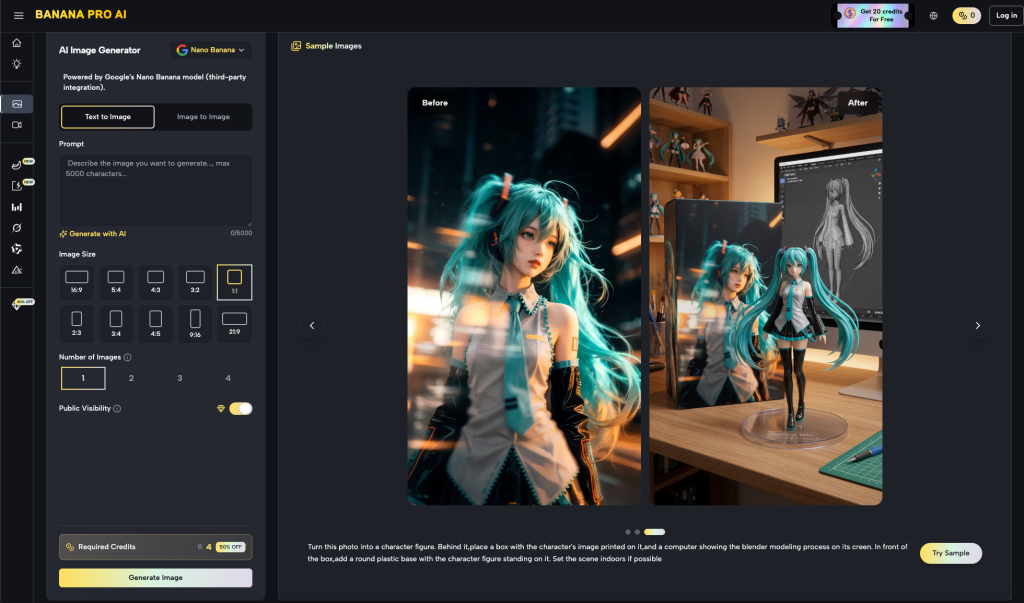
A tiered approach allows teams to burn “cheaper” cycles during the brainstorming and layout phases. By utilizing Nano Banana Pro for rapid prototyping, teams can visualize concepts in seconds rather than minutes. This speed facilitates a higher volume of creative “bets,” allowing the best ideas to surface before any significant compute resources are committed to high-resolution finalization.
The Architecture of a Tiered Workflow
Building a repeatable pipeline around Banana AI requires a shift in how we think about the “perfect prompt.” Instead of trying to get a flawless result in a single shot, successful operators use a tiered methodology:
- Phase One: Rapid Prototyping. Use high-speed, low-latency models like Nano Banana to test composition, lighting, and color palettes. At this stage, pixel-perfect anatomy is less important than the overall vibe.
- Phase Two: Selection and Upscaling. Once a composition is approved, the asset is transitioned into a higher-fidelity environment. This is where the heavy lifting occurs, refining textures and details.
- Phase Three: Surgical Correction. Rather than re-generating the entire image because a single element—like a product label or a hand—is off, the asset is moved into the AI Image Editor. This allows for localized fixes without resetting the entire generation.
This method respects the “compute budget” of the project. It is worth noting, however, that this tiered approach is not a universal fix. It is important to recognize that while a model like Nano Banana Pro excels at speed, it may occasionally lose the thread on highly specific text rendering or intricate biological symmetry compared to its more resource-heavy siblings. Operators must know when a prompt is too complex for a lightweight model to handle, even for a draft.
Optimizing Throughput with Nano Banana
The technical reality of Nano Banana is optimized for “time-to-first-pixel.” In practical terms, this means the model is streamlined to provide a coherent visual structure almost instantly. For a performance marketer needing to generate 100 variations of a background for a hero product, this is the engine that makes the workflow viable.
Using the Banana Pro platform, creators can leverage this speed to conduct what we call “creative stress testing.” If a campaign needs to feel “industrial but organic,” you can run fifty variations of that prompt through Nano Banana in the time it would take to get five from a larger model. The sheer volume of options increases the likelihood of finding a unique visual angle that wouldn’t have emerged in a more constrained, slower environment.
However, a visible caution for teams: scaling these workflows does not yet mean “set and forget.” There is a threshold of complexity where the efficiency gains of high-speed generation are negated by the manual oversight required to catch stylistic drift. If the model begins to hallucinate inconsistent brand colors across a batch of 200 images, the time saved in generation is quickly spent in quality assurance.
Surgical Precision with the AI Image Editor
The most common point of failure in an AI workflow is the “infinite re-roll.” This happens when a creator gets an image that is 90% perfect but has one glaring flaw. In a naive workflow, the creator changes the prompt slightly and hits “generate” again. This is a gamble. You might fix the flaw, but you will also change the 90% that was already working.
The AI Image Editor changes this dynamic by introducing a “non-destructive” mindset to generative work. By using inpainting or localized editing features, you can lock the composition and only change the problematic area. This is the difference between a tool-savvy operator and a hobbyist. The operator knows that the most expensive thing you can do is discard a “nearly there” asset.
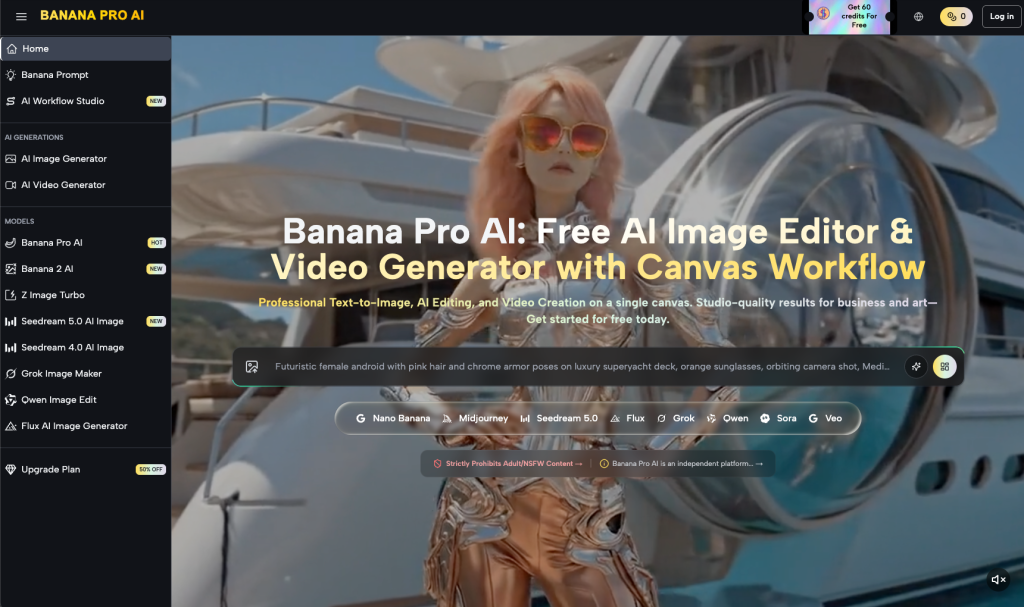
Within the Banana Pro ecosystem, the editor acts as the bridge between the raw output of the AI and the specific requirements of a creative brief. Whether it’s removing an unwanted object or adjusting the lighting on a specific subject, the editor ensures that the speed of the Nano Banana model is backed up by the precision required for professional delivery.
Balancing the Economics of AI Media
Every generation has a cost, whether it’s measured in credits, API fees, or local GPU electricity. For agencies, this cost must be baked into the project’s margin. A common mistake is assuming that all AI generations are “free” because of a flat-rate subscription. In reality, the time of the human operator is usually the most expensive part of the equation.
If an operator spends four hours coaxing a high-end model into producing a single perfect image, that image is incredibly expensive. Conversely, if that same operator can produce twenty high-quality, edited assets in the same timeframe by using a mix of Nano Banana and targeted editing, the unit cost of content drops significantly.
To manage these economics, teams should establish clear “exit criteria” for each stage of the workflow. For example:
- Spend no more than 10 minutes in the prototyping phase using Nano Banana.
- If a concept isn’t clicking after 20 generations, pivot the prompt or the model.
- Use the editor for all fixes that require more than two re-rolls of the full prompt.
The Human-in-the-Loop Reality
Despite the advancements in speed and the efficiency of the Banana Pro toolset, the “automated” dream remains a bit of a mirage for high-stakes work. The human element is still the primary filter for brand voice and aesthetic nuance. The goal of using tools like Nano Banana Pro and the editor isn’t to replace the human, but to remove the mechanical friction that prevents the human from being creative.
When we talk about “speed” in AI, we shouldn’t just talk about milliseconds. We should talk about the speed of the feedback loop between the human intent and the visual result. A low-latency model allows for a conversational relationship with the AI—you prompt, it responds, you tweak, it adjusts. This “flow state” is where the best work happens.
Final Thoughts on Scaled Production
Deploying AI at scale is an exercise in resource management. By understanding the strengths and limitations of different model tiers, creators can build pipelines that are both fast and fiscally responsible. The combination of high-speed generation for discovery and surgical editing for refinement represents the current state-of-the-art for professional AI workflows.
While the technology will continue to evolve, the fundamental principles of production—managing latency, controlling costs, and maintaining quality—will remain. Tools like those found in the Banana AI suite provide the framework, but it is the operator’s judgment that ultimately determines the success of the output. Focus on the workflow, respect the compute budget, and use the right tool for the specific task at hand. Only then does the “high-volume squeeze” become a competitive advantage rather than an operational burden.
